
Introduction
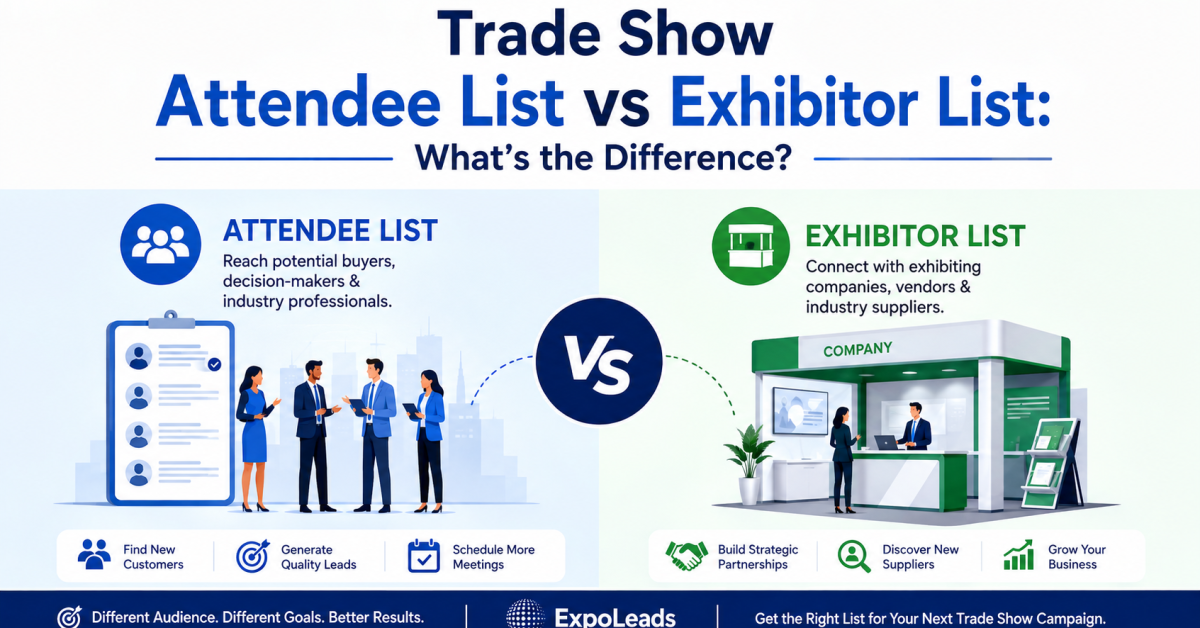
At trade shows, you’ll find two main groups: attendees and exhibitors. Many companies assume these groups are the same, but they’re not. One of the first key decisions in event lead generation is choosing between an attendee list and an exhibitor list.
If your company is looking for buyers, you’ll usually want attendee information. But if you offer services, equipment, or solutions to exhibitors, then exhibitor data is more valuable. Combining these lists into a single ‘event list’ often leads to irrelevant outreach, wasted sales time, poor engagement, and missed opportunities that are hard to recover from after the show.
This guide explains the differences between attendee and exhibitor lists, when to use each, how to combine them, and how to set up a prospecting campaign that matches your goals. It also shows how ExpoLeads can help you find the right event contact information, so your outreach reaches the right people instead of just a big list.
Quick Answer: Attendee List vs Exhibitor List
| Purpose | Identify people attending the event to learn, buy, or evaluate solutions | Identify companies presenting products or services at the event |
| Primary Audience | Buyers, professionals, and decision-makers walking the show floor | Exhibiting brands, manufacturers, and service providers with a booth presence |
| Best For | Customer acquisition, product promotion, meeting scheduling | Selling B2B services, partnerships, supplier or vendor prospecting |
| Typical Buyer | Businesses selling products/services to end users or professionals in the industry | Businesses selling to companies that exhibit — agencies, suppliers, technology vendors |
| Outreach Goal | Generate interest, book meetings, drive sales conversations | Open partnership or vendor conversations, pitch business services |
| Common Use Cases | Pre-event prospecting, product launches, market expansion | Competitive research, partnership development, supplier sourcing |
What Counts as a Tradeshow Attendee List?
An attendee list is a database of people who have registered for or previously attended a trade show or exhibition. These are the people walking the aisles, visiting booths, attending sessions, and making or influencing buying decisions in the event’s industry.
Attendee data can include a mix of professionals depending on the event and industry, such as:
- Buyers and procurement professionals
- Executives and business owners
- Engineers and technical specialists
- Operations and supply chain professionals
- Distributors and retail buyers
- Consultants and industry advisors
- General industry professionals attending to stay current on trends.
Why Businesses Use Attendee Data
Attendee lists are most commonly used to support four stages of a sales motion:
Before the event, sales teams review the attendee list to identify which companies and titles align with their ideal customer profile, then contact those companies in advance to introduce themselves.
For scheduling meetings, teams use attendee data to book specific times in advance instead of hoping to bump into people on the show floor. This usually leads to better, more meaningful conversations than casual booth visits.
Product promotion – when businesses are launching a product or have one featured at the show, they can use attendee data to ensure the right professionals are made aware of it before they arrive, increasing the likelihood they will visit the booth.
Attendee lists are also helpful for post-event follow-up. Even if you didn’t meet someone during the event, you can still reach out afterward and mention the show.
| Job title / role | Prioritize contacts that match a target buyer profile |
| Company name | Research account fit before outreach |
| Industry | Segment messaging by vertical |
| Business email | Enable direct pre- and post-event outreach |
| Location | Support territory-based sales planning |
| Event registration category | Understand attendee intent (buyer, visitor, professional) |
What Constitutes a TradeShow Exhibitor List?
An exhibitor list is a database of companies that are exhibiting at the event and their products or services. These businesses rent booth space, have staff at their stands, and are available to everyone at the show. Unlike attendees, who are there to buy, exhibitors invest in marketing to be seen at the event.
Exhibitor lists typically include organizations such as:
- Manufacturers presenting new products
- Technology providers demonstrating software or platforms.
- Service companies showcasing capabilities
- Suppliers and distributors expanding their reach.
- Industry vendors building brand visibility
Why Exhibitor Data Matters For a Different Reason
Exhibitor data isn’t mainly for finding buyers. Instead, it helps you spot companies investing in visibility, growth, and industry presence. These are good prospects for businesses that sell to exhibitors, both at the event and beyond.
Companies that commonly benefit from exhibitor lists include:
- Booth design and build companies
- Logistics and freight providers
- Event technology and lead-capture companies
- Printing and signage companies
- Marketing and creative agencies
- Lead-generation and data companies
- Software providers serving exhibiting industries
- Packaging companies
- Manufacturing suppliers
- Business consultants advising on growth or expansion
In other words, an exhibitor list isn’t about finding buyers. It’s about identifying companies with a budget, active in the market, and looking to grow. These signals are useful whether you’re selling services, seeking partnerships, or researching active companies in an industry.
Attendee List vs Exhibitor List: Key Differences
Beyond their basic definitions, the two data types differ in how they support sales or marketing strategies.
| Audience type | Individuals attending the event | Companies presenting at the event | Depends on objective |
| Buying intent | Often evaluating products/solutions in the event’s industry | Rarely evaluating industry products; more relevant for B2B services and partnerships | Attendee list for direct sales |
| Company visibility | Attendees are less visible before the event | Exhibitors are publicly confirmed and often listed by the organizer | Exhibitor list for research |
| Decision-maker targeting | Strong when job titles are available | Moderate — often requires further research to find the right contact at the company | Attendee list |
| Typical campaign goal | Generate leads, book meetings, promote a product | Pitch services, propose partnerships, source suppliers | Depends on objective |
| Sales cycle | Can be shorter if attendee is an active buyer | Often longer, involves vendor evaluation or partnership discussion | Varies |
| Partnership potential | Lower — attendees are usually individual roles, not company decision points | Higher — exhibitors represent whole organizations with budget authority | Exhibitor list |
| Supplier opportunities | Limited | Strong — exhibitors are often sourcing suppliers themselves | Exhibitor list |
| Service-selling opportunities | Limited unless attendee company matches service audience | Strong — exhibitors need services to support their presence | Exhibitor list |
| Meeting generation | Strong for pre-event scheduling | Useful for account-based partnership meetings | Both |
| Market research | Useful for understanding buyer demand | Useful for understanding competitive and vendor landscape | Both |
What can be seen is that attendee lists are generally aimed at demand-side activities — that is, at locating people who might be interested in buying something related to the event’s main industry, while exhibitor lists are generally aimed at supply-side activities, that is, at finding companies that need services, partners, or suppliers to support their own market.
What List Should You Select? It’s more helpful to relate this to your real objective.
| Generate new customers in the event’s industry | Attendee List |
| Reach purchasing or procurement professionals | Attendee List |
| Promote a new product to industry buyers | Attendee List |
| Schedule sales meetings ahead of the event | Attendee List |
| Sell services or solutions to exhibiting companies | Exhibitor List |
| Find business partnerships | Exhibitor List |
| Target potential suppliers | Exhibitor List |
| Find distributors | Attendee + Exhibitor |
| Expand into a new market | Depends on target audience |
| Build a broader event ecosystem strategy | Both |
When an Attendee List Is the Better Choice
Direct Sales to Ready Buyers
Building a Warm Pipeline Before the Show
Account-Based Marketing & Targeting Key Buyers
Market and Demand Research
Expanding Beyond a One-Time Sale
How to Segment Attendee and Exhibitor Data
| Job title | VP of Procurement vs. Marketing Coordinator | Ensures outreach reaches people with actual buying or decision authority |
| Seniority | Director-level vs. individual contributor | Helps match messaging complexity and offer to authority level |
| Industry | Manufacturing vs. healthcare | Allows industry-specific messaging and use-case examples |
| Company size | Enterprise vs. small business | Impacts budget expectations and sales approach |
| Geography | Regional vs. national accounts | Supports territory planning and travel logistics |
| Business type | Distributor vs. end-user company | Clarifies whether the contact buys, resells, or uses the product |
| Event role | Attendee vs. exhibitor | Determines overall messaging angle, as covered above |
| Buying relevance | Active buyer vs. researcher | Helps prioritize sales-ready contacts over early-stage researchers |
| Product relevance | Matches current product line vs. adjacent interest | Improves message-to-need fit |
| Sales territory | Assigned rep or region | Ensures the right internal team member owns the follow-up |
Example: Same Event, Two Different Campaigns
Let’s look at an example of a company at a manufacturing trade show with two different goals.
Campaign A — Attendee Audience
- Goal: Generate new customers
- Data used: Attendee list, segmented by procurement and operations titles
- Message: A direct invitation for a product demonstration and a scheduled meeting on the show floor
Campaign B — Exhibitor Audience
- Goal: Sell B2B services and explore partnerships
- Data used: Exhibitor list, segmented by company type and booth size
- Message: A business-solution pitch focused on operational support and potential collaboration
These two campaigns come from the same event but use different data, messages, and measures of success. That’s why attendee and exhibitor lists shouldn’t be treated as the same. They support two separate prospecting strategies at once.
How to Evaluate a Trade Show Contact Database
| Event relevance | Does the data actually correspond to the specific event and year you need? |
| Data freshness | How recently was the data collected or updated? |
| Contact fields | Are job titles, companies, and emails included, or only partial information? |
| Business email availability | Is business (not just personal) contact information included where available? |
| Company information | Is company name, industry, and size included for segmentation? |
| Job titles | Are titles specific enough to identify decision-makers? |
| Segmentation options | Can the data be filtered by role, industry, or geography? |
| Duplicate handling | Has the provider addressed duplicate or outdated records? |
| Data source transparency | Does the provider explain where the data originates? |
| Delivery format | Is the data delivered in a usable format for your CRM or outreach tools? |
| Intended use | Is the data appropriate for your specific campaign type? |
| Privacy and marketing requirements | Does the data align with applicable marketing and privacy regulations for your use case? |
How ExpoLeads Can Support Your Trade Show Prospecting
ExpoLeads helps businesses find attendee and exhibitor contact data for trade shows and exhibitions, so your prospecting starts with the right audience.
Depending on event availability, data categories can include:
- Name
- Job title
- Company
- Industry
- Business email
- Phone information where available
- Location
- Event classification (attendee or exhibitor)
- Other relevant professional or business information
ExpoLeads helps businesses figure out what’s actually available for a specific show before building a campaign.
Businesses use ExpoLeads’ event-focused data to support:
- Pre-event prospecting
- Meeting generation ahead of the show
- Customer acquisition campaigns
- Exhibitor outreach for B2B services
- Partnership development
- Market expansion research
- Post-event follow-up
Whether you want to find buyers, reach exhibiting companies, or do both, the first step is to understand which audience matches your goal.
Why Choose the Right Audience Before Buying Data?
Most people start by asking, “How many contacts can I get?” when talking about trade show data. But that’s usually not the best first question.
A more useful question is: “Which audience is most relevant to my business objective?”
A smaller, well-targeted list of attendees or exhibitors usually works better than a bigger, poorly targeted one. Relevance drives response, and response drives results. The right audience, combined with relevant messaging and timely outreach, gives you a stronger foundation than just having a large list.
Get the Right Trade Show Contact List with ExpoLeads
If you’re planning outreach for an upcoming trade show, choose attendee data, exhibitor data, or both based on your campaign goal instead of just picking one by default.
ExpoLeads can help you explore:
- Attendee Lists: for customer acquisition and buyer-focused outreach
- Exhibitor Lists: for service sales, partnerships, and supplier prospecting
- Attendees & Exhibitors: for businesses running parallel campaigns
- Custom Data Requirements: for specific events, industries, or targeting criteria
To get started, share a few details:
- Event name
- Industry
- Target geography
- Audience type (attendee, exhibitor, or both)
- Job roles or titles you want to reach
- Any specific business requirements
Tell us which event and audience you want to target. ExpoLeads can help you find the contact data that fits your campaign needs.
Other Service Providers for Event Contact Data
Businesses seeking additional sources of trade show contact data can review specialized platforms focused on event-related business information.
- ExpoLake : Offers attendee and exhibitor data for a range of trade shows and business events.
- ExpoAttendeeList : Provides event-specific contact databases covering attendees and exhibitors across different exhibitions.
When comparing your options, consider data quality, event availability, contact fields, data freshness, filtering options, and how well it fits your campaign.
Conclusion
Attendee lists and exhibitor lists serve very different purposes. Treating them as the same is a common but avoidable mistake in trade show prospecting.
Attendee lists work best for campaigns targeting customers and buyers interested in products or services. Exhibitor lists are better for businesses selling B2B services, looking for partners, or finding suppliers, since exhibitors are already investing in their market presence. These lists, with different messages for each audience, create a stronger trade show strategy than a single list.
In the end, the best choice depends on your campaign goal, not a set rule.
If you’re choosing between a trade show attendee list and an exhibitor list for an upcoming event, ExpoLeads can help you find the data that fits your goals. Contact us with your event and audience details to get started.
FAQ's
How can I get a verified trade show attendee email list?
You can explore official event sources, event networking platforms, internal research, or specialized trade show data providers. The best option depends on the event, audience, budget, and amount of data required.
How do I know if an attendee email list is accurate?
Ask about the provider’s validation process, update frequency, duplicate handling, event-source methodology, and request a sample before making a purchase.
Can I target specific job titles?
Depending on the available data, event contact lists can often be segmented by job function, seniority, industry, company, location, or other business criteria.
Should I buy an attendee list or build one myself?
For a small number of highly strategic events, internal research may be practical. Businesses targeting multiple exhibitions may find a specialized event data provider more efficient.