
What Is Event Marketing?
Event marketing involves promoting a brand, a product, or a service through in-person or virtual events while also generating leads, building relationships, and moving buyers along the sales funnel. It includes all the activities that a team carries out in connection with an event, such as promotion before the event, engagement during the event, and follow-up after the event.
Event marketing covers more than just trade shows. Trade shows are one type of event, but the category also includes conferences, summits, company-hosted user conferences, and field marketing dinners. For most B2B companies, trade shows still make up the biggest part of the event budget, usually about 50% to 70%.
Why Event Marketing Matters for B2B Businesses
In-person events remain one of the most trusted channels in B2B marketing. Recent industry research found that 78% of organizers rank in-person conferences, summits, and conventions as their organization’s most impactful marketing channel, and 47% of in-person event marketers say events deliver the highest ROI of any channel they run.
Buyer behavior backs this up. 72% of attendees are more likely to buy from an exhibitor they meet at a trade show, and over half request a direct sales follow-up on the spot. Cost is another reason events hold up: the average cost per lead at a trade show runs around $112–$186, compared to roughly $259 for a field sales call, making trade shows one of the more efficient channels for reaching high-value, hard-to-target B2B buyers.
The challenge is proving results. Nearly 40% of event organizers say they have trouble showing event ROI to leadership, and a 2026 survey found that 86% of teams can’t clearly link sales pipeline to the events they held. A structured event marketing strategy and accurate contact data are designed to solve this problem.
Types of Business Events
Trade Shows
Conferences
Expos
Summits
Networking Events
Setting Event Marketing Goals
- Lead generation – a target number of qualified contacts captured
- Pipeline generation – meetings booked or opportunities created
- Brand awareness – booth traffic, impressions, or media mentions
- Customer retention – meetings with existing accounts
- Product launches – press coverage and demo requests
How to Build an Effective Event Marketing Strategy
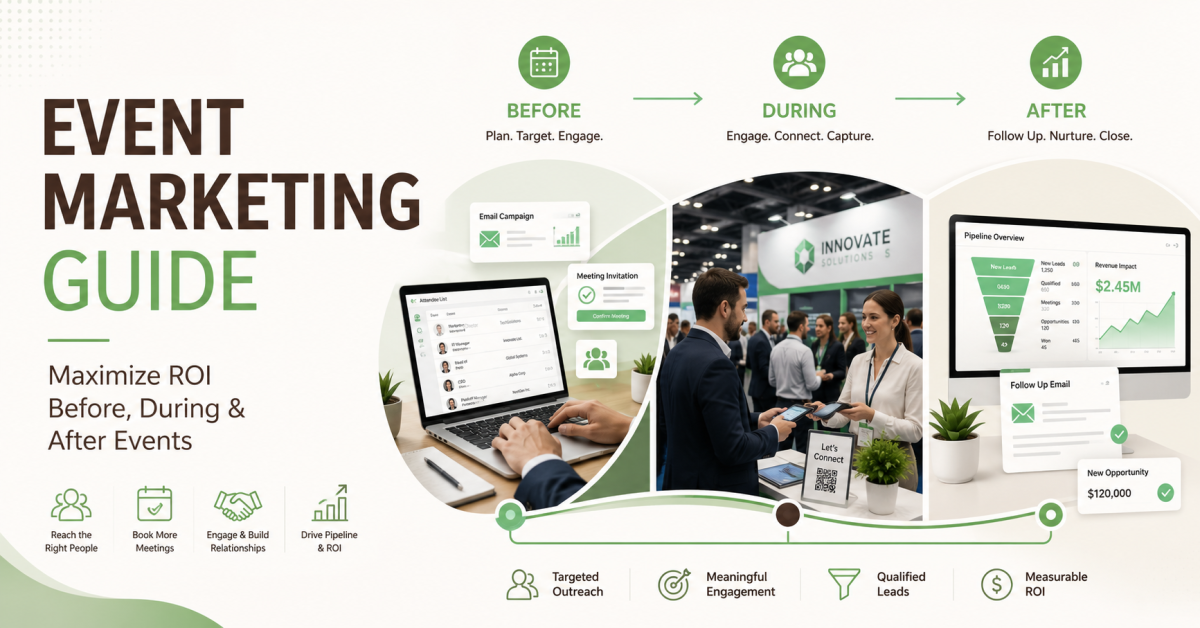
A strong event marketing strategy has three phases that all matter equally: before, during, and after. Most teams over-invest in the event itself and under-invest in the two weeks before and after it, which is exactly where deals are won or lost. One recurring finding across B2B event surveys is that 70% of teams cite a lack of visibility into who’s actually attending as their top barrier to booking meetings before a show, and more than half don’t start outreach until less than four weeks out. The teams that consistently generate pipeline start their outreach 8–12 weeks before the event, using verified attendee and exhibitor data to identify and reach the right people early.
This is where a provider like ExpoLeads.io fits in. Instead of guessing who’s going to be at an event, ExpoLeads gives sales and marketing teams verified attendee and exhibitor contact data, sourced using multi-verification, so outreach can start weeks before the show floor opens.
Pre-Event Marketing Tactics
Email Campaigns
Social Media Promotion
Landing Pages
A dedicated event landing page with a clear call to action (book a meeting, register for a demo, download an agenda) gives every campaign one place to send traffic and one place to measure it.
Paid Advertising
LinkedIn and industry-publication ads targeted at the event’s audience extend reach beyond your existing list, especially useful for reaching attendees you don’t already have contact data for.
Appointment Scheduling
This is the highest-leverage pre-event tactic. Booking meetings in advance, using a verified list of who’s actually going to be there, converts a passive booth into a full calendar of scheduled conversations. ExpoLeads’ filtered contact data by event, industry, job title, company type, and location makes it possible to build that outreach list and start booking meetings weeks before the show.
Marketing During the Event
Live Content
Real-time social posts, photos, and short clips from the booth or sessions keep your brand visible to people who couldn’t attend and reinforce your presence to those who could.
Networking
Staff should treat every conversation, not just scheduled meetings, as a qualification opportunity; badge scans and casual booth conversations both feed the same pipeline if they’re captured properly.
Booth Engagement
Interactive elements: demos, quick assessments, giveaways tied to a conversation rather than a raffle box, keep dwell time up and give staff a natural reason to ask qualifying questions.
Lead Capture
Every conversation should be recorded clearly: name, job title, company, and interests, captured right away instead of remembered later. Poor lead capture is a common reason event ROI can’t be shown afterward.
Post-Event Marketing Strategy
Lead Follow-Up
Speed matters enormously here. Companies that follow up within 24 hours of an event see roughly three times the pipeline value of those that wait a week or longer, and general B2B research shows that contacting leads within 24 hours can lift conversion by as much as 5x compared to slower response times. Yet the average B2B lead response time across companies is around 42 hours — meaning most teams are losing the advantage they paid to create.
Email Nurturing
Not every lead is ready to talk to sales immediately. A nurture sequence segmented by what the person showed interest in at the event keeps warm leads warm until they are sales-ready.
Sales Outreach
Multi-touch, multi-channel sales cadences outperform single-touch follow-up by a wide margin –most B2B deals require five or more touches to close, and sequences with 12–16 touches roughly double contact rates compared to shorter ones
ROI Measurement
Track cost per lead, cost per opportunity, pipeline generated, and closed revenue against the total event spend. Measuring too early undersells the result: B2B trade show ROI typically takes 60–180 days to materialize fully, so a 30-day report will almost always look worse than the event actually performed.
Common Event Marketing Mistakes to Avoid
- Starting outreach too late. Waiting until the week of the event to reach out means missing the buyers who already booked their calendars.
- Relying on scraped or outdated contact lists. Bad data wastes budget and damages sender reputation.
- Slow post-event follow-up. Even a strong booth conversation goes cold within days if no one reaches out.
- No clear goal per event. Without a defined objective, there’s no way to know if the event worked.
- Treating the event as a one-week project. The pre-show and post-show phases matter as much as the show itself.
- Measuring ROI too early. Reporting results before the pipeline has had time to mature undersells the program.
Best Tools for Event Marketing
A complete event marketing stack typically includes:
- Attendee and exhibitor data provider (like ExpoLeads.io) for pre-event targeting and outreach
- CRM systems to track leads from first touch to closed deal
- Email marketing and automation tools for pre-event campaigns and post-event nurturing
- Event registration and lead capture apps for on-site data collection
- Analytics and attribution tools to connect event spend to pipeline and revenue
How Attendee & Exhibitor Data Improves Event Marketing
The single biggest lever in event marketing is knowing who’s actually going to be in the room before you get there. Verified attendee and exhibitor data lets teams:
- Build a targeted outreach list weeks before the show, instead of hoping for booth traffic.
- Book meetings in advance with the buyers who match their ideal customer profile
- Filter prospects by event, industry, job title, company type, and location.
- Feed a CRM-ready dataset directly into existing sales workflows.
This is exactly the gap ExpoLeads.io is built to close. Rather than inferred titles or scraped contact lists, ExpoLeads provides verified attendee and exhibitor records sourced from multiple verification sources covering more than 90k global events, 30+ industries, and over 87 million verified contact records, with 95% field-level accuracy. Over 1,200 sales and marketing teams already use it to plan outreach, book meetings, and follow up after the show, all from data delivered in a CRM-compatible format.
Event Marketing KPIs to Track
- Cost per lead and cost per qualified lead
- Meetings booked before the event compared to meetings held at the event
- Booth traffic and engagement rate
- Lead-to-opportunity conversion rate
- Pipeline generated and closed-won revenue
- Follow-up response time
- Overall event ROI (revenue generated divided by total event spend)
Future Trends in Event Marketing
Personalization driven by AI is now being applied at every stage of the event process, ranging from registration procedures that use AI assistance and therefore achieve far higher conversion rates than standard forms to AI-improved webinars used for pre-event and post-event follow-up.
There is also an increasing number of organizations choosing to host their own conferences and summits rather than attend events put on by others, mainly since owned events provide clearer attribution and better conversion per meeting.
Meanwhile, the accuracy of the data and the ability to attribute outcomes are becoming key factors in determining whether an event budget is continued into the next planning phase, teams that can demonstrate a return on investment using accurate, verified data end up receiving larger budgets, not smaller ones.
Conclusion
Event marketing works when it’s treated as a full campaign, not a single week on the calendar. The strategy has to start before the doors open, with the right people already booked in, and it has to continue after the event ends with fast, consistent follow-up. The teams that consistently turn events into pipeline are the ones doing the unglamorous work early: building the right target list, reaching out weeks in advance, and following up within hours, not days.
It all starts with knowing who will actually be there. ExpoLeads.io provides sales and marketing teams with verified attendee and exhibitor contact data from the trade shows, conferences, and expos their buyers already attend. This way, outreach, meeting booking, and follow-up can begin before the event, not after.
FAQ's
What is the average ROI of a trade show?
Well-run trade show programs typically generate 4–6x pipeline value relative to total program spend, though results vary widely by industry and how quickly leads are followed up.
How soon should I start pre-event marketing?
How quickly should I follow up with leads after an event?
Where can I find confirmed contact information for attendees and exhibitors?
ExpoLeads.io provides verified, CRM-ready attendee and exhibitor data across more than 90,000 global events, filtered by industry, job title, company type, and location.